Exciting forays into the TV, movies, books, and web sites worth geeking out over. Will also feature other random topics of interest to the intrepid blogger.
So I know people were concerned, based on the advertising and the title, that this show was going to be sexist. Well, I randomly decided to watch the first five episodes and thus far, it doesn't trouble me at all. The story revolves around a young, successful woman named Rebecca. She's a Harvard and Yale-educated attorney who is on the verge of being made a junior partner at her law firm. She has everything she could possibly want, but she's stressed out, does nothing but work, and is utterly miserable. She keeps seeing these butter advertisements that ask, "When was the last time you were truly happy?" Well, one day she's walking down the street and she sees Josh.
Josh, you see, was her camp boyfriend when she was 16. He's a sweet, hunky dude with a positive personality and a laid-back attitude. When he sees Rebecca, he tells her he's been living in New York for a few months, but it's just not for him, so he's moving back home to West Covina, California. As an aside, he tells her it's too bad they didn't meet sooner, seeing as she's so hot and successful now. He tells her if she's ever in California, she should give him a call.
Rebecca's eyes glaze over as Josh walks away, and before you know it, she's turning down the partnership and moving to West Covina, California.
From day one, Rebecca is majorly in denial about why she moved to California. After all, West Covina is no paradise. It's portrayed as a shabby suburb four hours from the beach with an overabundance of pawn shops, cash advance stores, and strip clubs. But she insists to everyone that she is here for a fresh start, and West Covina just happened to be the perfect place for her. Yet, all the while, she's still looking for a way to get back together with Josh.
Despite Rebecca's decision to move across the United States to chase some guy she dated over a decade ago, she's actually pretty damn relatable. She's someone who was miserable and looking for a way out, and Josh just happened to suggest one. She has a feverish need for other people's approval, perhaps to make up for the approval she never got from her parents, and much better work skills than personal skills. She's also witty and quirky and prone to make literary allusions and do things like give courtly bows. All these things make her a girl after my own heart. And she's not entirely unaware of how bad her decision-making skills are. The one time she starts to realize that she moved to West Covina for Josh, she almost has a nervous breakdown. Luckily, her paralegal/new BFF, Paula, was there to talk her down from the ledge.
Oh, and did I mention that it's a musical? Yeah, that's the best part. For example, there's the "Sexy Getting Ready Song" in episode 1, which actually shows how unsexy the process of getting ready to go out really is. (Body hair removal, anyone?)
Then there's the song about her girl crush, Valencia the yoga instructor, in which Rebecca confesses that she wants to grind Valencia's skin into a powder and snort it like cocaine. My personal favorite is "Face Your Fears," a song Paula sings when she's trying to encourage Rebecca to throw a party to get Josh to come over.
In any case, this show surprised me. There were some aspects of the plot I was 100% on board with, but I'm willing to see how they play out and I didn't find them upsetting or offensive. On the whole, though, I enjoyed it immensely and ended up going through the first five episodes in a single night. So if you like musicals, check out an episode and prepare to be surprised, yourself.
I love Game of Thrones. I really do. It fills a fantasy-shaped hole in my heart (and TV viewing schedule) I scarcely knew existed before it came along. But it's because I love the show that I feel the need to point out what it could do better. So I'm weighing in, and I'm starting with the latest and most controversial move the show has made: the rape of Sansa Stark..
Now, before you start groaning and asking me, "Didn't you know this was a bleak show when you started watching?", let me point out that I don't object to rape being included in the plot. Craster's daughters were raped by their father and by the men of the Night's Watch, and while I did not find that pleasant, I accepted it because it made sense for the story they were trying to tell. But the problem with what happened to Sansa isn't so much that it's upsetting (though it is). The problem is that it's crappy writing.
Just as recently as the end of the last season, the show made a promise to us in the form of Sansa Stark sweeping down a staircase, looking like a Goth empress ready to enter the game and destroy the hearts of her enemies. It was a glorious transformation for the weak, wide-eyed girl from Winterfell who once thought being Joffrey's queen was the realization of all her fondest dreams. Having had those dreams ripped down around her ears via her father's execution and Joffrey's sadistic abuse, we finally saw her emerge from the ashes like an elegant, dark-clad phoenix. She made the decision to lie and protect Littlefinger, who she judged to be her best ally, and apprenticed herself to him to learn how to play the game. She showed agency and cleverness in this, as Littlefinger is one of the game's most astute players, and one uniquely susceptible to Sansa's charms based upon his fondness for her late mother.
When Sansa found out that Littlefinger had arranged for her to marry Ramsey Bolton, she was justifiably freaked out and confused, as was I. Why on earth would she want to marry the son of the man who killed her mother and brother? But when Littlefinger explained that it was a way for her to wreak revenge, I was somewhat mollified. Now, I supposed, we would finally see Dark Sansa in action. There was further support for this notion when Sansa was reminded by an old serving woman in Winterfell that "the North remembers," and that she had supporters. In my head, I began to have glorious visions of a Stark coup as our clever young lady played upon the anger and sympathy of the Stark loyalists to bring down the man who murdered her family.
Then Ramsey started torturing her emotionally at dinner, trotting out Theon and having him apologize for murdering her brothers before deciding that Theon would walk her down the aisle at her wedding. "Well," I thought, "this is just stoking the fire. It's just going to make her angrier and hungrier for revenge, to be reminded of what she lost and who she lost it to." But I felt a little dubious. I mean, things weren't looking good, and I still didn't see any signs of Sansa's grand plan taking shape. She had to have one, though, right? I mean, otherwise, why wouldn't she have just lit the damn candle that she knew could summon someone to help her? "No," I assured myself, "she's definitely building to something."
Then she married Ramsey and he raped her while Theon watched. And our next episode shows her curled up in the fetal position, under lock and key, forced to piteously implore Theon to light the candle because Ramsey's been raping and hurting her nightly.
And that's when my temper finally snapped.
Really? I mean, really? You're telling me that after all this Dark Sansa crap, all this apprenticeship to Littlefinger, and all these apparent decisions she's been making to land herself here, she's back to just wilting in a corner while she's abused by a sadist? Given that she's looking to be extricated from her situation via the candle, it's pretty clear that she doesn't have any long game here. Which basically begs the question of why she didn't light the f--king candle in the first place, back when she could move about freely and before she was cruelly deflowered? Why would she go through this when she didn't have to unless she had a plan? But how could she have had any kind of plan if she's just flailing helplessly to try and get the candle lit at this point?
So basically, Dark Sansa wrote a check that this story couldn't cash. Instead of signalling her rise to try her hand at the tricks and manipulations of the game, it was basically just a stopover on her round trip back to being Helpless Victim Sansa. Which I wouldn't have been half as angry about if they hadn't promised me more.
Ultimately, I need movements in a story to mean something. As my beta reader will tell me, I shouldn't write things into a novel that I don't plan on doing anything with, because it's a good way to build up reader expectations without any payoff AND waste precious space. And in a TV show with a hundred freaking characters, they really don't have the space to waste. So I devoutly hope that in the future, the show plans out narrative arcs for the character that follow a path that offers some form of payoff, instead of doing loop-de-loops in the plot parking lot until people get bored and annoyed and start wandering off. If you promise me a player, then you better let her play the damn game.
I have resisted getting Netflix for ages, a move that has resulted in many of the people in my life questioning my life choices. However, as an avid comic book fan, I knew Daredevil would be my breaking point. At the very least, I had to at least get the one-month trial when the show was released and see if it lived up to my fangirl expectations.
Color me stunned. After devouring all 13 episodes in a 48-hour period, it took me a day of rest just to be able to speak about them intelligently. And here I am, still fumbling for words to explain just why this show rocked my world.
I guess the best way to explain what Daredevil does well is to explain all the pitfalls it neatly avoids. Even the best TV shows I watch of late suffer from at least two big problems: (1) uneven character development and (2) poor pacing. With the first problem, perhaps our main character is developed, but too many of the people around him/her are paper cutouts we’re supposed to care about, but don’t. There might be some thin, cliche attempts to make the antagonist have depth, as well, but they’re often just no good rotten scoundrels in a way that real people seldom are.
With the second problem, you see shows racing to throw out all their best moves upfront to keep people watching. They rush romances to their ultimate conclusion far too soon and then having to manufacture obstacles to keep them from devolving into uninteresting domestic bliss. The story is also in such a hurry to get somewhere that the writers neglect to build up coherent supporting details or allow for any emotional investment. Or, just as bad, the story plods along, meditating endlessly on things that don’t ultimately seem to matter to the story being told. Some shows seem to alternate between the rush and the plodding, leaving the viewer feeling vaguely seasick. It suggests a lack of focus and planning, and a fuzzy view of their endgame for the season and for the series, altogether.
On both these fronts, Daredevil owns the competition.
First of all, Daredevil handles character development like a boss. From Matt Murdock, our blind lawyer turned super-powered vigilante (portrayed by Charlie Cox), to his BFF, Foggy “Foggybear” Nelson (portrayed by Elden Henson), to criminal defendant turned secretary, Karen Page (portrayed by Deborah Ann Woll), everyone who walks across the screen in this show is given enough development to feel like a believable, relatable human being. And it’s not just these characters. Secondary characters like Ben Urich (portrayed by Vondie Curtis-Hall), our world-weary news reporter, and Elena Cardenas (portrayed by Judith Delgado), a beleaguered tenant in danger of being driven from her rent-controlled apartment, also get enough attention to make them interesting and beloved. To top it all off, the cast has amazing chemistry. Every time that Foggy and Karen are involved in hijinks, Matt and Foggy are bantering, or the three of them are coming together in a moment of solidarity, pure television magic happens.
As for developing the main character into someone worth following, this, too, is a serious home run for Daredevil. One of the things I particularly like about the show is that it does not shrink from showing how difficult the life that Matt Murdock lives would actually be. Often, we see superheroes getting thrown into walls and hopping up, ready to shake it off and get back into the fight. In Daredevil, Matt's heroics are utterly brutal, and often leave him beaten senseless and bleeding. He shows resilience, which is explained partially by his family legacy of Murdock men being able to absorb a beating like nobody's business (his dad being a boxer), but he still takes punishment to do what he does. This makes the fact that he runs out there, still stitched up and bruised from the night before, all the more heroic, but also shows that he's at least slightly unbalanced. He doesn't seem to care much for his personal well-being, so fixated on saving the city that he loves that nothing else matters. There is an obsession here that is both admirable and deeply unhealthy. The way the show depicts his backstory- explaining how he was blinded, his upbringing, and about how he lost his father- it all makes perfect sense. After seeing where he came from, you have to wonder if he could have turned out any other way.
But it’s not just the protagonist types who get the star treatment around here. No, our big bad, Wilson Fisk, a.k.a. "the Kingpin" (expertly portrayed by Vincent D’Onofrio), also gets his time to shine. And boy, does he shine. A hulking menace with an almost nervous, quiet disposition at times, Fisk has own business, his own friends, and even his own love interest to see to. His world does not revolve around the actions of a single vigilante who is trying to interfere with his operations. More realistically, he often has bigger fish to fry as he busies himself with coordinating the factions of the organized crime in Hell’s Kitchen while envisioning himself as the neighborhood’s ultimate savior. He and his world are complex, and just as deserving as attention as Matt’s. It's only as the show progresses that these two forces begin to circle each other more closely.
And the plot unfolds just like a flower, one petal at a time, until there is an explosion of goodness all up in your peepers. There is no rush to get people hooked up. Foggy’s obviously digging on Karen. Karen isn’t necessarily on board with that, but seems to be in the throes of a possible schoolgirl crush in Matt's company. Matt, himself, has ridiculous chemistry with Claire (portrayed by Rosario Dawson), the nurse who patches him up after his extracurricular activities leave him worse for the wear. However, the show does not appear to be in a rush for anybody to start picking out china patterns, allowing sparks to grow and fizzle where they naturally may. Meanwhile, who is out there finding true love? Wilson Motherf--ing Fisk, that’s who.
Additionally, while the action is beautifully done and ever present, this is a show that isn’t afraid to spend most of one episode with two best friends having a terse conversation at a pivotal moment in their relationship. This may sound like boring stuff, watching two guys argue in a room with the occasional flashback, but I was hunched over on my couch, leaned in towards my TV with tears in my eyes, going, “Oh my God. Oh my God, what’s going to happen?” the entire time. The tension played out beautifully, and the subject of the conversation, alone, was enough to keep you riveted.
In sum? This is basically some of the best TV I've watched in a long time. It’s become one of the shows that I feel I have to preach like the gospel, right up there with Game of Thrones and (sometimes) The Walking Dead. I feel so passionately about the quality of what I've seen so far that I need other people to know, and I feel almost certain that everyone who takes me up on it will come back pleased. So even if you don’t take me up on any of my other recommendations, heed me on this: watch Daredevil. Trust me, you won’t be sorry.
All right, two episodes into season 6 of True Blood and I'm just going to say the words I never thought I'd say: I do not hate Billith. I started this season braced for the agony of seeing somber, elegant Bill Compton reduced to a bloody naked psycho. Instead, he seems like his old self as he hasn't been since season 4, only with a mysterious destiny and strange new gifts. (Hands free human-juicing! Neat!) Two episodes in, I care about what Lilith wants from him for the first time ever, and I am captivated by the relationship between Bill and Jessica. Jessica continues to dazzle as the unexpected badass one minute who becomes the sweetly vulnerable fanged girl next door the next. She keeps Bill grounded and attached to his humanity in a way that Sookie never did, and the way Bill cares for her is touching.
Jessica Hamby: bringing daddy issues to a new level since 2008.
Although, episode two's vision of Lilith filled me with mixed emotions. As relieved as I am that Lilith finally got herself a nice dress, I don't know why her homegirls can't do the same. Nobody is ever going to take these chicks seriously if they keep slinking around with the bloody full frontal nonsense.
The other pleasant surprise for me was becoming curious about Warlow. I spent all last season out of f--ks to give about Sookie's ancestor trading her to a vampire for magic beans or what have you. After listening to her whine endlessly about how being different SUCKS and watching her throw a magical temper tantrum, I just wasn't that worried about it. I figured that even if he took her, Warlow'd bring her right back before you could say, "You're hot, but not THAT hot."
Little does Sookie know that Warlow is actually the
lead singer of Vampire ZZ Top.
"She's got veeeeeeins... And she knows how to use them."
The introduction of the enigmatic fairy grandfather, however, suddenly kicked this plot up a notch. Leaving aside the fact that the man is one Hell of a snazzy dresser, he makes for an dapper Yoda to Jason's clueless Luke. Their interaction in episode two was priceless as he tried to drive home to our gung-ho Mr. Stackhouse the seriousness of his predicament and to prepare him to defend Sookie from her would-be captor. And the moment where Jason enthuses about being a fairy prince, only to get completely shut down with "the gene skipped you" just about made up for the yawn fest that this plot represented last season.
I would totally watch a buddy cop show starring these two.
The jury is still out, however, where this vampire persecution angle is concerned. @sabrinaslibrary and I were skeptical about humans having the technology to counter every magical ability a vampire might possess. I mean, come on. I don't care how many humans you have with how many fancy toys, centuries old beings with super powers should GENERALLY win the fight.
And any time you invoke a holocaust motif, which appears to be where this is headed, you have to tread lightly. Conjuring the specter of genocide that smacks of real historical atrocities requires a clever and respectful hand, because the attempted murder of an entire race isn't something to be trotted out for kicks. Besides, this wiener of a governor hasn't been developed yet, but I'm inherently skeptical of his ability to get the jump on even one vampire, let alone several. They should so be beating him up for his lunch money about now. I am, however, on board with Eric's magical seduction of the weasel's daughter and I enjoyed the Hell out of undercover Bible salesman Eric, even if he does give me the willies.
Um, Disguised Eric doesn't look like a guy who
wants to wear your skin while he talks to Jesus at all...
The other question mark bordering on an emphatic "NO" is Andy's passel of giggling fairy babies. Sure, it was a hoot to see his fling spurting out offspring while moaning in sexual ecstasy last season, but as I watched his babies become 5 year-olds overnight, I thought, "So what?" This is starting to smack of more random, pointless nonsense a la Terry and the ifrit that takes up time that could be devoted to a more worthwhile plot. Besides a possible reality show about the trials of being the single father of supernatural multiples, I do not see what Andy and his kids have to offer us.
All this is time that I'd rather be spending with Pam and Tara. Pam is unquestionably my favorite character on the show. Her lines were most of what kept me coming back for more last season despite bloody naked chicks and the vampire PTA. Seeing her mentor and then smooch Tara made it all worthwhile in the end. I wait with baited breath to see her emotional development this season as we continue to learn about the vulnerable woman beneath the big-haired badass. And with even greater excitement, I anticipate the hilariously deadpan Pam remarks to come.
"Come on, E, smile. I'll make jokes about my sandy cooch again!"
Where I have to just throw up my hands and wail in frustration is with regard to Alcide's plotline. This show has developed the most unfortunate habit of building up good guys just to knock them down in ways that don't even make sense. First, Bill Compton, he of the strong moral code and eternal yearning to cling to his humanity, suddenly becomes a vampire Dr. Evil who slinks around doing unthinkable deeds on the thinnest of justifications. And now that he's rehabilitated into some semblance of a consistent character, we feast our eyes on the train wreck that they call Alcide Herveaux.
Does anybody remember a time when this guy was a gentle, good-hearted man trying to do right by everyone? Back when he was introduced and he and Sookie started shooting each other considering looks, Alcide struck me as the decent man a gal ought to pick once she's gotten over her hankering for bad boys and decides to settle down. He was the steady, loyal, dependable man, the equivalent of sexy broccoli: he's good for you and you know it, but damn it, sometimes you still want ice cream!
"Don't you wish your broccoli was hot like me?
Don't you wish your man-broccoli was a stud like Alcide?"
The fact that his romance with Sookie ended before it began due to vomit is upsetting enough. There was so much build-up and then suddenly all prospect of this show that started as a vampire romance actually having romance in it anymore went to Hell. But when Alcide decided to have rough sex with the next trashy wolf babe he met last season and then kicked off this season by having a three-way with his new alpha bitch and a random stray, my eyes could not roll hard enough.
Really? Really??? So not only do we still not get Sookie and Alcide together, but now Alcide gets to be just another horny power-hungry douchebag? Do we not have enough of those around already, or is he just trying to fill the void left by Russell Edgington's demise? And would good guy Alcide EVER have traumatized a little girl by beating the crap out of her protectors and dragging her away into the night without at least trying to talk things through? Whatever happened to the guy trying to do right by everyone? One little three-way and suddenly he's too cool to have human decency?
It's disappointing, to say the least. I don't mind a plot that brings out the dark side of a good man, but it needs to be developed properly and it needs to have a point. What's more, we currently have a dearth of decent people on this show. Everybody's innocence is long lost by this point and most folks here seem to err on the side of naughtiness. An uncomplicated Boy Scout is a boring character, but a man of principles who struggles to do right CAN be interesting if he has layers and occasionally makes the wrong decision. What's been done here with Alcide knocks down the last shred of light in Bon Temps and leaves us all struggling around in a maze of dim bulbs.
However, on balance, this season has been a marked improvement over last season. The driving plot is interesting again, and the main characters have stopped their bitching, sulking, and random nonsensical evil and have started to make sense again. I care about almost everything that's going on, and am no longer watching strictly to stare at Alcide shirtless while laughing at Jason and Pam. Still, I want to see the love come back to this show, the emotional connection, and consistent character development. This season seems like its finally correcting True Blood's wayward course. If they can keep on making progress, I may yet find myself becoming a born-again Truebie by the season's end.
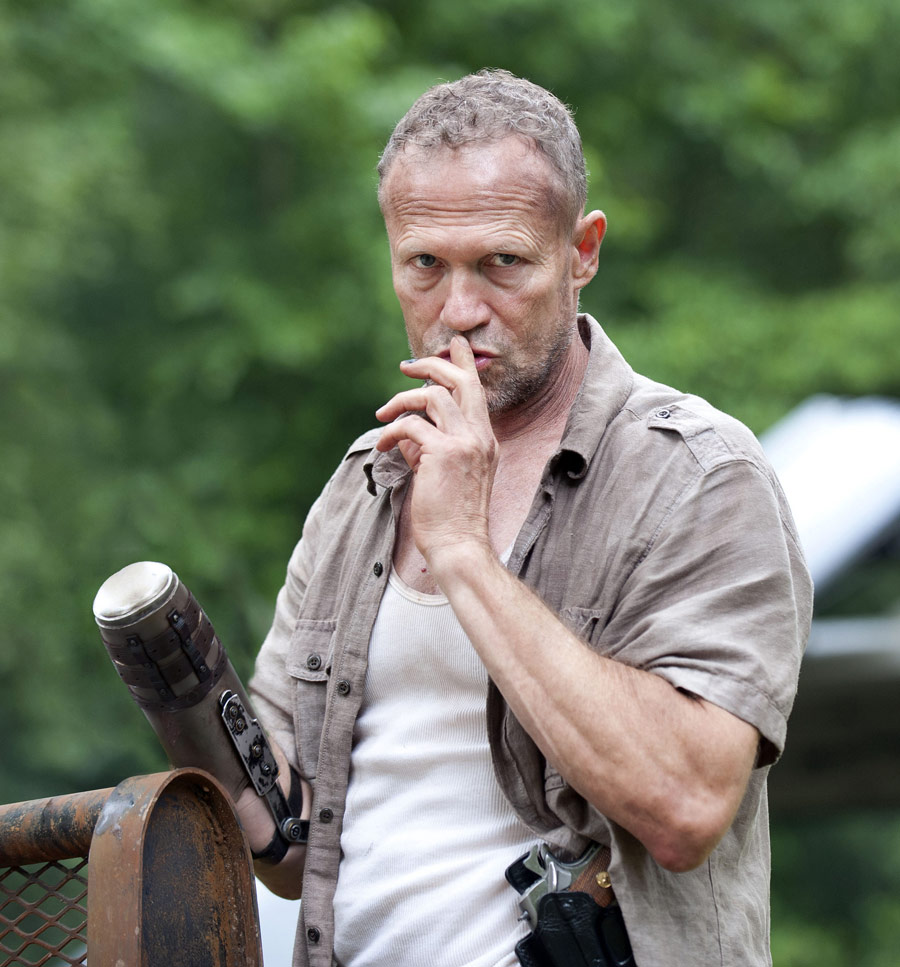
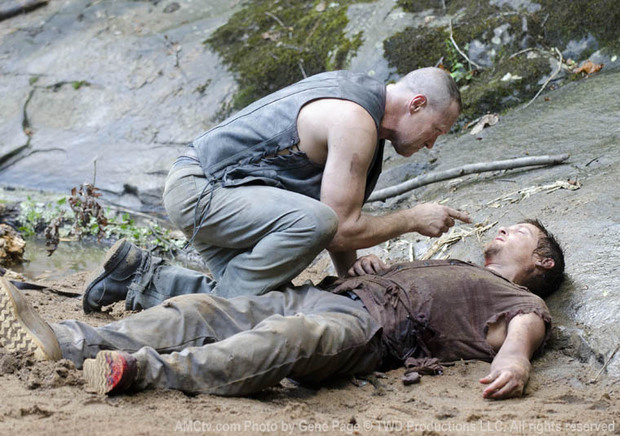
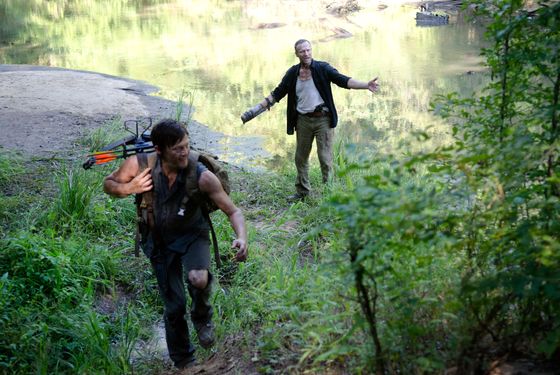
The death of Merle Dixon echoed through the "Walking Dead" fandom like a gunshot. For a moment, there was only stillness and horror as we watched Daryl dissolve into sobbing, inconsolable grief. Then, as the younger Dixon stabbing his zombified brother's face into a messy goo and the credits rolled, the internet erupted.
Admit it. If you ran into a zombie with a knife hand, you'd poop yourself and die.
Some folks were pleased. They never liked Merle. And honestly, what was there to like? Merle was a drug-using racist asshole who was introduced to us in season 1 as the guy playing alpha male and popping shots off in the middle of zombie-filled Atlanta. When he turned up as the sadistic right hand of the Governor, no one was really surprised. Merle had "henchman" written all over him. The way he pummeled Glenn into mush and then shoved a walker in to finish him really cinched it. Merle was the devil. He recognized that everyone must see him that way, himself, in "This Sorrowful Life."
"Buck up, son. This is still better than if it came to arm-wrestling."
But Merle had always given hints that he was more than just a redneck stereotype fit only for slaughter. For one thing, whether you love him or you hate him, you can't deny that he's a complete badass. I don't think a single one of us can imagine having the stones to saw off our own hand, stumble downstairs without fainting, and cauterize the wound on a stove. And even if we could even manage such a thing, I doubt the average Joe would be able to fight his way out of Atlanta one-handed and haul ass to safety while weak from blood loss. No, I think in Merle's situation, most people would've curled up into a weepy, shivering ball of human misery and waited for death to find them.
Coming back as a hallucination in season 2, Merle was as antagonistic as ever, haranguing a fallen Daryl with a varied and colorful array of insults to his manhood and fortitude. But even as a hallucination, there was a sense that Merle considered himself to be acting for Daryl's own good. And indeed, through his stinging hail of verbal barbs, he drove his weary brother up and out of the gorge so that he could seek treatment for the injuries he sustained in his fall.
"And if you do not go, I shall taunt you a second time!"
When we finally catch up with the corporeal Merle and his shiny new knife-hand in season 3, the only thing our pal Merle can think of once he knows Daryl's still out there is finding his baby brother. And you have to wonder why. Merle's been painted as an unsentimental hardass up to this point. He's not a nice guy, he's not a caring guy, and we'd never actually seen these two interact in the flesh. It seems like a harsh question to ask about any human being, but I had to wonder, did he want his brother back because he loved him or was it a control thing? Did he miss his brother's company, or did he have to have him because he was HIS brother?
*singing* "I can't liiiiiiiive... if living is without you!"
Honestly, I didn't know until the two Dixons left the group to fend for themselves in "Home." Predictably, despite Daryl leaving the people he'd come to care for and respect to be with Merle, Merle continued to berate and deride his brother. And seeing Daryl spurred to heroics to help stranded strangers escape from walkers doesn't make Merle any kinder. He clearly regarded his brother's bravery as the worst sort of foolishness. But then their conversation takes a turn. Merle is aghast to discover that his brother had taken the beatings Merle used to suffer at their father's hands in Merle's absence. It sets him back, throws him off his macho game, and leaves him fumbling for equilibrium. You can tell he hates that this happened to his brother, and he wants to make things right somehow, but he knows that he'll never be welcome at the prison. In the end, he goes back, because Daryl makes it clear that he's going back with or without him.
"This Sorrowful Life" then gives us Merle in his death throes, thrashing like prey in the jaws of an alligator. He knows how they all see him. Even as Daryl tries to talk Glenn into forgiving Merle for that whole attempted murder business, Merle is aware that the group looks at him as the bad guy and probably always will. There's something particularly wild in his search for drugs in the prison bedding. I saw someone who can't stay still, who can't stay within his own skin without the benefit of a little medicinally-induced dullness.
He seemed to welcome the grim, murderous task of delivering Michonne. This was the best they could expected of him, that he would do their dirty work for them. And he decided, when Rick asked him to do it, to live up to their expectations. If they wanted him to be soulless garbage, then he would be soulless garbage and do the thing that none of them had the stomach for. And Merle decided there would be no going back on this. Rick wanted him to be the hooded executioner taking the taunts and jeers of the crowd for him, and he was going to carry out his orders even if they were rescinded. So he took Michonne and bore her off to be their sacrificial lamb.
She did get under his skin, digging in about how he wasn't the man he tried to pretend he was. That he wouldn't lament being a bad guy if he really was one. And truthfully, it was telling that he had never killed anyone before the apocalypse and that he kept count of those he did since then. The count suggested to me a man who felt each death leave a mark on his soul, which wouldn't be the case if he had no soul to speak of.
When Merle let Michonne go and went on his sniper mission against the Governor's men, we all knew Merle had decided then that he wasn't coming back to the prison. That he wasn't coming back anywhere, if he could help it. But the why of it had people confused. And yet, while I wholeheartedly agree that the motivation behind Merle's final mission could have been much more clearly developed, I completely understood it.
In this episode, Merle realized that his brother had a new family. Daryl had a place in the prison, with these people who cared for him and respected him. They would never feel that way about Merle. He could only linger in the shadows, pissing them off and accepting the brunt of their hateful stares as his due, and be the outsider there by Daryl's grace alone. And chances are, he was going to screw it up for Daryl. I think when he was hunting up drugs, he could feel the restlessness that drives him to sin stirring, wanting to fight and rant and raise Hell. And he may have been trying to resist it, to dull it, but he'd give in eventually and ruin everything. Then he'd put Daryl in the position of choosing between Merle, who didn't know how to treat him well, or the group of people who did.
It was a self-fulfilling prophecy. Merle had come to see himself as the others did, to believe himself incapable of better. And because all he could do was drag Daryl down with him, he did the only useful thing he could think of: he decided to take himself out of the picture and bring as many of those Woodbury bastards with him as possible.
What he couldn't do was go back and face the group after doing exactly what was expected of him. He couldn't pretend like he was capable of being a better man. He just had to fight as cleverly and as brutally as only he knew how, and hope that his brother would be better for it.
Which actually showed that he would have been capable of being a good man, if he had only been able to believe it, himself.
"You've got to play the hand you're dealt. I only got one."
I wasn't happy that Merle died in the end. I was torn apart by Daryl's reaction, and by the notions of what might have been if Merle had just had an ounce of faith in himself. And for myself, I suspect that even if this had to be Merle's end, it could have done him more justice if we'd gotten to see a few more glimpses of the man he really was beneath the bad guy, the henchman, the racist redneck and verbally abusive older brother. There was more to Merle, and we only scratched the surface. But I was happy to have the answer to my question in the end. Merle did love Daryl, and he loved him more than his own life.
It should come as no surprise to anyone that I'm a stickler for the rules. The rules of the road, the rules of polite behavior, the rules of good social media etiquette, the rules of Scrabble (stop playing foreign words, damn it!)... I don't see them as just arbitrary limits on one's freedom, but usually as a logical means of creating order or preventing an evil. When they exist, they usually exist for a reason. And no matter what kind of rules we're talking about, before you can break them, you should at least understand why they're there in the first place.
Now, as any avid reader of fantasy knows, there are rules to fantasy literature, as well. They may not be carved in stone and there are plenty of rule violators out there who do quite well. But generally, the people who break the rules of the fantasy genre fall into two categories: (1) total newbs who had no idea there were rules in the first place and (2) genius-types who can expertly turn such rules upside down, usually for a specific purpose or with such cleverness that nobody minds.
When two fantasy-themed TV shows, "Once Upon a Time" and "Grimm", came traipsing into my life, rules were the last things on my mind. My nerdy heart was all a-flutter at the notion of the genre I so love filling my TV screen as artfully as it filled the pages of my favorite books. "At last," I thought, "television shows that cater to my interests. Let the magic-wielding mayhem begin!"
Then cue my dawning disappointment. Apparently, the writers of these shows didn't get the memo about the fantasy genre having rules. Episode after episode, I waited to see that there was something up their sleeves I wasn't expecting, some trick that would make me see they were the genius-types and not just clueless newbs who wanted to play recklessly in the fantasy playground. Unfortunately, two seasons into both shows, it's not looking good.
So as a learning experience and to explain how I went so quickly from devotee to disenchanted, I am going to go through exactly what some of the rules are, how the shows have broken them, and why the violations are problematic.
RULE 1: MAGICAL VILLAINS NEED LIMITS
"Don't mind me and my lightning hands and my monster steed. I'm a pushover underneath all this majestic awesomeness." Original image found here.
The Rule: Whenever you're putting a mystical black hat into play, setting out his or her weakness is almost as important as picking out a properly villainous name. (Nobody cowers from the Vile Wizard Herbert.) True, it can be a psychological one- arrogance can cause a villain to underestimate his opponent, or perhaps he's got issues that make him get sloppy when the hero's taunts strike a nerve- but generally, when it comes to magic-users, magic should also come with a cost. It can be physical pain, a fatigue that sets in, a narrow range of abilities, or the limitation that a spell dissipates from the mind after use and has to be relearned. It could also be that their power is bound to a physical object that can be taken or destroyed. In the end, it doesn't matter what it is, it just has to be there.
The Reason:Imagine you're reading a fantasy novel you just picked up at the bookstore and you're really digging it. The quality of the writing is stellar and you totally relate to the main character. Then the villain walks in in chapter two. It turns out he's an all-powerful demigod with every magical gift under the sun who can keep flinging bad voodoo 'til the cows come home.
Maybe now you're wondering how this guy can EVER lose. Also, maybe you're thinking even if He Of The Limitless Power can be taken down, it's not gonna be by some plucky chump with a sword like the main character. So while you want the hero to save the day, if he/she does win, it's gonna seem pretty darned improbable.
One might keep reading after that, waiting for the villain's Achilles' heel to be revealed. But if you're only getting mounting awe at the villain's magical prowess with no sign of any advantage to the hero in sight after a certain number of pages, the book in your hands is eventually going to start looking like a 500-page waste of time. And in TV terms, magnify that loss of time by multiple episodes across several seasons. Now let's all hit the "do not record" button on our DVRs together.
The Rule-Breaker: "Once Upon a Time" is the primary offender.
How it's a problem: In the fantasy world of "Once Upon a Time", Regina is the evil queen from Snow White. They make it readily apparent from the start that she is so much more than a vain royal who clocks in too much mirror time; she's also a sorceress of boundless talent. She disappeared into thin air when Prince Charming threw his sword at her at his wedding. She cast the curse that banished the fairy tale characters to the magickless limbo they now inhabit in our world. She attacked the guards in Wonderland with plant life and she poisoned Snow White's apple with a sleeping spell. She ripped out the Huntsman's heart and eventually squished it into gooey bits. And she also seems to know everything that's going on in her world with the possible exception of where that pesky stepdaughter of hers has gotten to. With her limitless range of abilities and no sign of any spellcaster's fatigue, one has to wonder how even decent fighters like Charming and Snow could ever get the better of her.
It was more acceptable in season one, which was dominated by the magickless setting of Storybrook, Maine. There, Regina was limited to whatever small magicks she'd brought with her and her own guile. Then season two brought the magic into our world, and suddenly the only limit on Regina's ability to kick good guy ass is that her magic is a little more unpredictable and she doesn't want to upset her adopted son. And as we all regard her newfound self-control dubiously and remember that this is the same woman who had her husband assassinated, sent a man to cut out her stepdaughter's heart, and stabbed her own father, Regina's mother, Cora, has come into play in the fantasy world. And Cora is even worse than Regina when it comes to appearing to have no discernible limit to her magical prowess.
Too long, the show has progressed without it being readily apparent how anyone can get the drop on these two. At this point, I worry that no matter how much I admire Emma, Snow, Charming, and the gang, there is no way in Hell that they should be able to defeat these bad mojo-wielding mamas. If there were going to be limits or rules governing Regina and Cora's magic, they should've long since manifested. At this point, even if they're mentioned, they're going to seem like an afterthought. And that's just sloppy world-building.
On a related note...
RULE 2: THE HERO SHOULD BE UP TO THE TASK
Hey, this guy may not be in shape like Superman, but he can sure kick the Sunday crossword puzzle's ass! Original image found here.
The Rule:Whenever you've got a bad guy engaged in a reign of terror and you meet the guy who's gonna make it all come to an end, you usually need some indication of why this guy will succeed where everyone else has failed. Is he a good fighter? Does he have some mystical destiny? Does he have good information about the villain's aforementioned weaknesses? What makes the hero so damn special, after all?
The Reason: Mostly, it just seems like less of an admirable feat for our main character to defeat his nemesis if it seems like dumb luck or that anybody with a pulse could've managed it. And you have to wonder, if it's that easy, why didn't someone else step up? So you need to know exactly what the hero has going for him that makes him uniquely suited to his quest.
The Rule-Breaker: I'm looking at you, "Grimm."
How it's a Problem: I've said it before and I'll say it again: I do not understand why all the supernatural creatures on "Grimm" are terrified of Nick. He can see them, sure. He also has what amounts to a supernatural burn book ("Ooo, those hexenbiests are vicious bitches!") and an arsenal of ye olde weaponry. So he definitely has the right tools. But still, he's fighting things that look like were-animals, complete with slashing teeth and claws and some of whom have magic and/or poison, in addition to enhanced senses and supernatural strength. And yet our good-looking but otherwise seemingly normal cop seems to take them down with relative ease.
HOW?! What is the big stinking deal about being a Grimm? If there's something else to it, I really should've found out before the second season began. Otherwise, it's like reading a Spiderman comic and not finding out that he actually has superpowers until issue 10. How many people would've stuck around that long thinking our hero was just a quippy dude in spandex?
Without knowing why Nick is uniquely suited to his mission, I don't quite believe that he is. And every single episode, as I watch him take down yet another monster, I wonder why just about anyone with his aunt's book, a crossbow, and a set of magical beer goggles couldn't accomplish the same thing.
RULE 3: MAGIC SHOULD HAVE LOGIC
"Hey, Rocky, watch me pull a madman out of this hat!" Original image found here.
The Rule: While magic has an inherently surreal quality that allows it to defy all the laws of physics and reason, it should not be utterly devoid of logic. There should always be a structure governing any magical system. We should be able to tell, to some extent, where the magic comes from and how it works. Do your spellcasters have to mumble arcane words memorized from books? Do they operate using potions or enchanted objects? Do they possess an innate gift for magic, or can anyone who has the right book and ingredients start conjuring away? How does it all work? And once you explain the mechanics, you have to stick to them. If we're talking about spellbooks and crystal balls, I'm going to call shenanigans if suddenly someone just points a finger and starts spouting lightning bolts. This same rule applies to magical artifacts and beings. Everything has rules to follow.
The Reason: In some ways, this loops back around to rule # 1. We need to know how it works to know what to expect from the magically gifted and the objects we encounter. It helps guide our understanding of the plot and set up the battles knowing what each party is capable of. How things work out, or don't work out, then makes sense within this magical system. Otherwise, your story will seem like the fantasy equivalent of a Michael Bay film- all random explosions, gunfire, and ass-kicking without a point.
The Offender:If you noticed my thinly veiled rage about Jefferson's hat in my earlier post, you know this is about "Once Upon a Time."
How it's a Problem: From day one, I could not completely understand how Regina's magic operated. Some things she accomplished just because she wanted to, like her disappearing or manipulating shrubberies. Some things, like the curses she cast, seemed to require book learnin' and perhaps a trip to the apothecary's. So I'm not entirely sure how magic works in the fairy tale world.
I thought I understood how magic worked in Storybrook in season one. Because, well, it didn't. That's what everyone kept saying, right? Then Regina smooshes the heart of the local sheriff- and countless fangirl hearts with it- and I am all kinds of puzzled. OK, obviously, she's still got some tricks then, yes?
Enter the enchanted objects, such as Jefferson's hat. Jefferson, a.k.a. the Mad Hatter, can't seem to make his lovely little felt wormhole work properly because there's just no magic in our world. Cue his plan to kidnap Emma, the sole individual from the fairy tale world who has any resistance to the curse. He is convinced that Emma can make the hat work again. Emma is a little more skeptical, but she gets to craftin', 'cause, you know, he has weapons and a hostage. Then Jefferson gets shoved out of a window and appears to have disappeared into the hat...
...only to pop up a few episodes later telling Regina that he can't make the hat work on account of the lack of power in this world. But... but... How is he not all broken up and concussed, then? And how did he manage to disappear after Mary Margaret's act of defenestration?
Then Regina tells him that she really can't do anything without magical artifacts from the fairy tale world, and she's clean out. So how did the heart thing work, then? Was the heart, itself, an enchanted object when it came into this world? Inquiring minds want to know.
Inquiring minds are also growing tired of waiting for things to make sense. After a time, one wonders if things like Jefferson's semi-functional portal hat were just goofs by the writers, who suddenly decided that they needed the hat not to work to enable a future plot point. And one finds oneself unimpressed by such oversights.
RULE 4: WORLDS SHOULD HAVE DEFINITION
That awkward moment when two worlds collide outside of an officially sanctioned game of bumper worlds. Original image found here.
The Rule: This one is an odd one, because most of the time it doesn't necessarily come up. But if we're talking about a fantasy world that bleeds into other worlds, unless the plot revolves around in jumping from one strange universe to another, it's always good to give the reader a frame of reference. Are we looking at multiple worlds, or two parallel worlds? How easily can one move between them, and what are their limits?
The Reason: Working these details out will sometimes alert you to inconsistencies or plots that reek of random nonsense. Plus, our setting needs to be tied in with what the plot is trying to accomplish and the theme of the work. And if you keep darting to random worlds that seem unrelated and unnecessary, my fantasy jet lag might make me decide to deplane and take a cab back to the real world. FOREVER.
The Offender: Yes, this about "Once Upon a Time" again. Apparently, if this show were to ask the magic mirror who the most rule-breakingest show of all was, the answer would be its own reflection.
How it's a Problem: "Once Upon a Time" likes to push its limits, and typically, I like that in a show. Because of this, I've let some odd things slide. For instance, despite the show's concept being built on the notion of Grimms' fairy tales, I was okay when we tugged in folks from Wonderland and Neverland. Neither are Grimm creations and both are actually meant to be their own discrete locales, but the essence of the stories about these worlds was similar enough that I was willing to allow it.
Then somehow Frankenstein got involved. And... I died inside.
My feelings about this development can best be summed up by a scene in "Anchorman: The Legend of Ron Burgundy", when the characters are discussing past loves. Trying to be included in the conversation, Brick starts saying he loves the carpet and the desk and the lamp, forcing Ron to inquire, "Brick, are you just looking at things in the office and saying that you love them?"
At this point, I feel like Ron Burgundy, with "Once Upon a Time" as Brick. Stroking my impressive mustache, I inquire, "Once Upon a Time, are you just saying random things now? Do you really think Dr. Frankenstein makes sense in this plot or did you just throw it in because you tripped over a copy cleaning out your attic last weekend?" And then I retire in a huff to languish among my many leather-bound books.
There is no rhyme or reason to the inclusion of Dr. Frankenstein as a character in this show. He is not a fairy tale character, there is no real fairy tale theme to his story, and Dr. Frankenstein's world isn't even a discrete world such that it gels with the notion of world-jumping via Jefferson's hat. What's more, we're now genre-jumping, as well, because Frankenstein is generally regarded as a horror story. So not only am I not sure what worlds I'm dealing with here anymore, the inspiration being invoked is creating unsightly thematic inconsistencies even more frightening than Dr. Frankenstein's monster. It's enough to make a gal want to take up a torch and pitchfork in protest.
CONCLUSION
So there you have it; the problems that have bumped these shows from must-see TV to "I guess if I have a lot of time to kill, maybe someday I'll catch up" all boils down to the rules. In TV as in literature, you have to master the game before you can change the rules, and I am not convinced the creative minds behind either show have enough mastery to get away with their shenanigans.
At this point, it's "so long and thanks for all the fish!" from me as I depart with lessons learned, but then, that's just me. There are probably others who disagree. Maybe you're the type who firmly believes the rules are made to be broken. Or perhaps you think there's a method to the madness that I have somehow overlooked. If so, hit me up in the comments! I may be all about well-defined worlds, but I am wide open to conflicting opinions!
The last season of Glee did not fill me with the emotion that the title promised. It was hard to put my finger on exactly what wasn't working for me. The best I can figure is that after two stellar seasons that smartly balanced the chuckles and the drama, able to sing out with feel-good bubbliness in one moment and lament as melodiously as Billie Holiday the next, the third season started to feel like it was playing to the audience too much. The laughs felt forced, the plotlines lacked conviction, and the twists were painfully predictable. (Yes, we knew they would win at nationals before the seniors graduated and that Finchel wouldn't continue on with our boy keeping house for his happy starlet. Cause Glee may not always nail it, but the writers are not brain dead.)
They did throw in a Christmas wookie, though. If that's not a ratings saver, I don't know what is.
After the airing of "The New Rachel" last night, this season smells vaguely of redemption (perhaps with an undercurrent of teen spirit). It's not flawless, mind. There's a little been-there-done-that to some of the plotlines we've seen so far, such as the group losing sight of their policy of acceptance for all due to competitiveness and a yearning for popularity. Not only has this idea surfaced before, but in this episode, it wrapped up almost faster than one could recognize it. It might have been intriguing to see the Dark Side of the Glee club for a change (in fact, I'd pay good money to see a little Darth Britney), but it would have ultimately felt wrong to see our sweet and scrappy underdogs going all "Mean Girls." So discarding this notion was probably smart.
The Glee Club: Give us your tired, your nerdy, your out-and-proud gay men yearning to be free.
And Puckerman the sequel worries me. Don't tell me he's going to start out as a bad seed and learn the value of friendship through membership in the glee club, because I can already see that coming from a mile away. Then, all that will separate Jake Puckerman from his brother, Noah, will be the impregnation of a cheerleader and a subsequent lust for larger ladies. As for our singing Pollyanna, Marley, the offspring of the much-derided lunch lady, she concerns me as well. She's somewhat charming in an overwrought Oliver Twist kind of way right now, but she's going to need to develop some complexity to avoid being as two-dimensional as a Disney princess.
Want to hear a new level of wardrobe fail? Our musical pauper is
depicted as wearing a thrift store sweater that her mom sewed a
J. Crew label in to make her cheap-o duds look cool. When I moused
over this image on the original site, it gave me the option to shop the look.
However, what thrilled me to no end was how well Glee incorporated our recent grads. I smelled doom when most of characters who made life at McKinley High seem worthwhile moved on, leaving behind newbies and a few folks who made stellar supporting characters, but were questionable as leads. What reassured me and has me engrossed anew was the integration of plotlines for our favorite new New Yorker, Rachel Berry, and the man who brings style to lurking at the high school after graduation, Kurt Hummel. Those two, alone, make the whole show worthwhile. But it also gives me hope that they'll find a way to incorporate Puckerman (the elder) and Finn into the current plot, especially with Carbon Copy Jake now skulking around the high school. This will be absolutely necessary until Glee can deliver lead characters on par with Rachel, Finn, and Kurt and develop them enough to make us love them.
Concerned that the leftover gleesters can't carry the show?
Never fear, Fancy Man is here! Look upon his cravat, ye mighty, and despair.
And Kate Hudson. Kate Kate Kate. I had not been tracking the spoilers, darling, so it was a lovely surprise to see your unfairly gorgeous mug here. Kate Hudson as Rachel's dance teacher is the most delicious of bitches. She sets her sight on "Ms. David Schwimmer," as she keeps referring to Rachel, and seems determined to grind her under the heel of her tap shoes before the first semester is through. And yet, she's not so bad, as we see in her brief but supportive interaction with a TA who just landed his first Broadway role as a flying monkey in Wicked. Their conversation shows that this Grinch's heart may be two sizes too small, but it does exist, only perhaps it's a bit broken over her own lack of Broadway success. Her singing and dancing was divine, her performance quite capable, but this is a role that could also end up like a stock character from a thousand other stories. The broken, has-been alcoholic who scorns others out of pain is very well-traveled territory. I like where they're going with this so far, but Glee will need to watch its step to keep this character from becoming too cliche.
She's obviously a cold-hearted snake. Look into her eyes.
With the dramatic reunion between Rachel and Kurt at the end of the episode, Glee leaves us with the hope of good things to come. Certainly, as discussed, there are some false notes and missteps, but the general theme remains one worth singing along to.
Are these musical puns doing it for you? Cause this last one will have you doing a...


.jpg)