Exciting forays into the TV, movies, books, and web sites worth geeking out over. Will also feature other random topics of interest to the intrepid blogger.
Every time I pick up a Blackthorn and Grim book, I know I'm in for a suspenseful, sometimes heartbreaking, but always rewarding ride. This book was no exception. This particular tale follows our cantankerous healer and her gentle giant of a friend as they become entangled in the goings on in nearby Wolf Glen-- the construction of a heartwood house that brings special blessings on the person who completes it, the return of a wild man who has been trapped in otherworldly servitude for years, the problems of a girl to whom the trees speak and the birds protect, and the threat of a terrible secret that could change the lives of everyone in Wolf Glen forever.
Honestly, the mystery in this book was exceptional, but I was in it, and will always be in it, for the relationship between Blackthorn and Grim. There's something so powerful between them, so much love, and yet, they are both so damaged they refuse to admit it fully. It makes me bounce in my chair every time they let slip how much they care for each other. For instance, when Grim is explaining why the wild man can trust him with his story, and the wild man asks if he will tell his family, Grim responds, "No wife. No family. Only Blackthorn. My friend. My trusted friend, who I live with. And yes, I might tell her. But that's not the same. Telling her's like telling the other part of me. She'll keep your secrets, same as I will." That, right there, had me swooning.
In the end, I cannot recommend this book and the series it falls within strongly enough. The writing is beautiful, the plotting is strong, and the characters become like old friends you pine for between books. Go out and get your copy today!
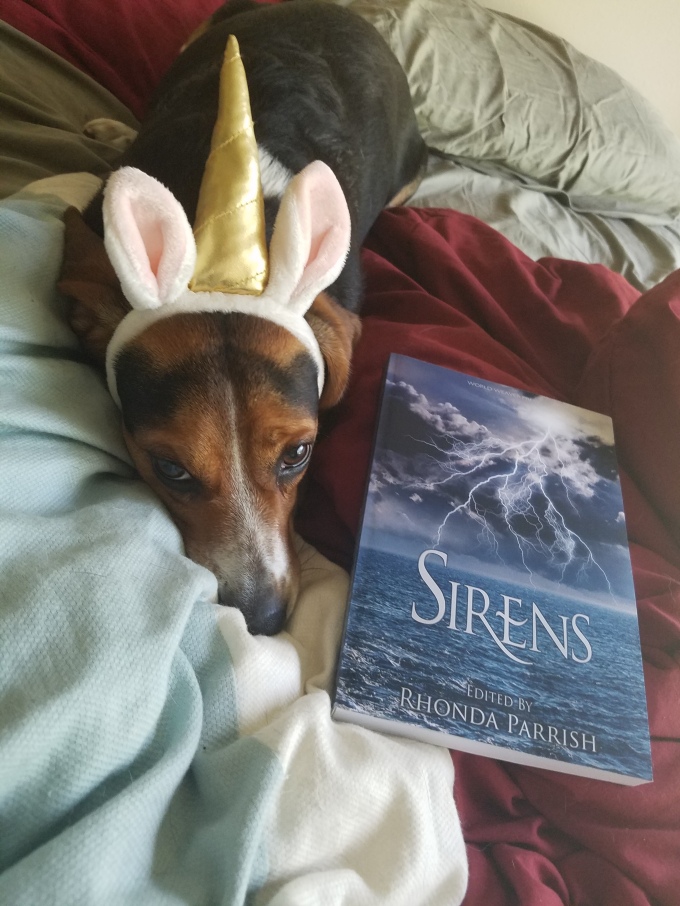
The Sirens anthology comes out today, stuffed to the gills with siren-y goodness. My story, "The Fisherman and the Golem," lies waiting inside to entice you into deep literary waters, and it is in some stellar company. If you're wondering where you can pick up your copy, see below for details!
Anyhow, I do hope you'll pick up a copy, and if you do, I'd appreciate you taking the time to review it on Amazon and Goodreads! It's a great signal boost for the anthology, and I'd love to hear what you all think of it!
Incidentally, Bailey the cosplaying beagle gave it 5 out of 5 stars! Even better than a slice of cheddar cheese, and at least as good as a tummy rub.
Long before a lovable orphan named Harry suffered at the hands of the Dursleys, a lovable cricket-playing orphan named David Allard was hating life with his awful relations, Uncle Bernard, Aunt Dot, and Cousin Ronald. He tries hard to be grateful for the way they've looked after him since his parents died, but it's tough when all they seem to want to do is criticize him or send him away. When he gets stuck in their company one summer, he glumly anticipates months of misery.
That is, until he meets Luke. Or, if Luke is to be believed, until he released Luke from a magical snake-filled prison.
At first, it seems like Luke, charming and fun as he might be, is just plain bonkers. However, David's skepticism is put to the test when he's able to summon his new friend with the flick of a match. Add to that Luke's ability to start fires and wither plants with a touch and maybe he's not so crazy, after all.
But the trouble is, the folks who put Luke in prison aren't pleased by his escape. One by one, they show up to try to trick or force Luke's location out of David, with the most savvy participant in this battle of wills being a one-eyed gent who keeps company with a pair of ravens.
Ultimately, David will bargain with the one-eyed man to try to keep Luke safe, thereby embarking upon a quest that takes him through a bevy of Norse myths come to life.
EIGHT DAYS OF LUKE is a charming tale steeped in mythology, but offering a new and unique perspective on it. Between Diana Wynne Jones' capable prose and the likable main character, the pages flew by for me. Odd as he was, I also loved Luke, and at least one of David's relations turned out to be unexpectedly kind. If I had any quibble with this book, it's that I'd hoped for some clever twist or reveal as the pieces came together, a la HOWL'S MOVING CASTLE, but alas, I knew my Norse mythology too well to be surprised by certain aspects of the plot. Still, even without any shocking twists or turns, this book is entertaining and well-written. I had fun trying to guess how each character and location fit into the Norse mythology motif. I thoroughly enjoyed it, and would recommend it to any mythology buff looking for a fun read that still has some cleverness to it.
All right, I recently got tagged in one of those Facebook games where you're supposed to list 18 books that had an impact on your life. And of course I cheated and listed entire series for some, because I have too many favorite books to be tied down to a mere 18. #StickingItToTheMan! Anyhow, because this is a pretty comprehensive list of my very favorite books in the whole world and I hope to entice others into exploring these literary gems further, I thought I would post my list here for all to see. So here it is, in no particular order.
1. The Lion, the Witch, and the Wardrobe by C. S. Lewis
The first fantasy novel I ever read, it was my first step down a path leading to a lifelong passion for the genre. My love for this book is what made me start writing my own stories. In case you're not familiar with the story, it's about four children sent to live with a professor in the country during the London air raids of World War II. There, the youngest stumbles upon a magical wardrobe connected to a winter-bound world and sucks her siblings into a quest to help the talking animals of Narnia defeat the White Queen. Influences from the fairy tale, the Snow Queen, and from Lewis' own Christian faith abound.
Piers Anthony was the guy who showed me that fantasy didn’t have to be all “throw the ring in the fiery mountain lest we all be doomed.” It reminded me that there can be fun in the genre, that characters can fight evil and there can still be laughter and nonsense. Besides, who doesn't love a good pun, especially a magical world filled with puns that just happens to be shaped like Florida?
3. Child of the Northern Spring by Persia Woolley
My childhood best friend's mom read this book to us one night while I was spending the night at their house. I think this is where I learned to love Arthurian legends, and I haven’t stopped hunting down good retellings since. Woolley's version of Guinevere is about the only version of the character I've been able to stand. She is a living, breathing, flawed character who I root for in spite of knowing her ultimate fate.
4. The Crystal Cave by Mary Stewart (and all the ensuing books in that series)
Luckily, after Child of the Northern Spring created my thirst for Arthurian legends, I found stellar books like this to slake it. This historical, yet still legendary series is part of the reason that I love Merlin so. In Stewart's books, he's not just a wise old sage. You watch him grow from a shy child to an old man, and he feels like a real person. What's more, the likes of Arthur, Uther, Ygraine, and the gang come to life on these pages more so than in any other retelling I'd seen in ages by the time I discovered this series. I reread these books until they almost fell apart.
5. Merlin’s Harp by Anne Eliot Crompton
Another brilliant Arthurian legend that puts a relatable gloss on the story without losing its legendary feel. This is one of the most original takes on Mordred’s role in the story and on the Lady of the Lake's identity. The seamless way Crompton wove the pieces of the legend into a framework of her own creating is one of the many reasons I used to reread this book on a yearly basis. Add in her mastery of the language and it's a book I never hesitate to recommend.
6. The A Man of His Word series and the sequel series, A Handful of Men, by Dave Duncan
I had been writing my own stories for years by the time I read these books, and they influenced me heavily. I was awed both by Duncan’s brilliant imagination, which created one of the most interesting worlds and magical systems I've ever read about, and by his ability to juggle dozens of plot threads and then handily tie them all up at the end in a way that felt right and natural. And seldom have I been as engaged by any set of characters as I was by his. I still love Rap beyond speaking to this day. Notably, Rap was one of the first fantasy heroes I'd ever read about who wasn't described as ridiculously good-looking, too, and was, in fact, a bit on the unattractive side.
7. Deerskin by Robin McKinley
There are a lot of worthwhile McKinley books to seek out, but this one stands out to me as the best of them all. It takes a shallow French fairy tale that makes light of a father’s interest in marrying his daughter (insert this face here: O_o) and gives that plot weight and consequence. It takes the wronged princess on a journey from victim to survivor that was meaningful and moving using language so beautiful it's worth reading just for the effortless descriptions, alone. I have never been so torn apart by a fairy tale retelling, only to be put back together into a better version of myself. Every time I put the book down, smiling through my tears, I immediately want to go through it all again.
These books came along when I was getting bored by the fact that every fantasy hero seemed like a noble, studly piece of beefcake with wicked fighting skills and a flawless mind. People who never do the wrong thing are kind of hard to relate to. Then Fitz came walking into my literary life. Fitz may be a good-looking sort, but he is far from perfect. Leaving aside that he’s the bastard son of a disgraced prince and ends up becoming a royal assassin, he’s a mess of a human being. His intentions are generally good, but he often acts selfishly or impulsively and makes his situation worse. Which is actually infinitely more interesting to read about than a bunch of perfect people who don't know the meaning of the word "mistake." The world Hobbs created in these books is one of the most well-developed and fascinating ones I've ever seen and her writing is beautiful.
9. The Enchanted Forest Chronicles by Patricia C. Wrede
These books also came along to save me when I was getting bored with the same old tropes and Super Serious Plots. They were also a ray of light in a world that seemed crammed with people trying to write spunky heroines who ended up coming across as annoying or overbearing. Cimorene was my ideal heroine: smart, capable, tired of being underestimated, but never beating you over the head with a sign saying, “I am woman, hear me roar.” The books were charming and light, but with just weight enough to be satisfying. One of the first novels I ever wrote that I was proud of when it was finished, The Humble Abode, was heavily influenced by these books.
10. Neverwhere by Neil Gaiman
I didn’t discover that Neil Gaiman until I was in my early twenties. I don’t know where his books had been all my life before that, but clearly, I had been missing out. And though I love just about everything he's ever written, this is, by far, my favorite of his books. It’s so dark and rich and inventive, and Croup and Vandermar are my absolute favorite literary villains. I could've stayed in London Below forever, even if it slightly terrified me.
Though I had known and loved the movie since I was a child, I was skeptical about reading the book. Growing up in a My Little Pony world had convinced me that unicorns were silly and girly. But Peter Beagle’s unicorn is not a My Little Pony unicorn. There’s magic and majesty and tragedy about this creature, mixed with a charming vanity and vulnerability that make her relatable. And Beagle's use of the language is some of the most gorgeous, imaginative, poetic writing I’ve seen. Not to mention the fact that the love story twists up my feels in the most glorious way. This book reminded me of why I wanted to be a writer at a time when I was wondering if it was all worth it. If there's a shot in Hell that I'll ever write anything as half as good as this, it mostly certainly is.
(Read my full review of this book here. Also, check out my review on Tamsin, which is my second favorite Beagle book!)
12. Ombria in Shadow by Patricia McKillip
I’m gonna be honest: I did not like the way this book ends. And you know what? I don't even care a little bit, because it was the first McKillip book I’d read and it was so gorgeously written I’d have forgiven her if she’d just stopped writing halfway through. Within 6 pages, I was so heavily invested in the characters that I couldn’t look away. I’ve read whole books and not cared that much! Domina Pearl has also joined Croup and Vandemar in my villainous hall of fame, a sort of old lady Darth Vader to their pair of well-spoken brutes. And I swooned harder over a romance that was only mentioned in flashbacks in this book than I have about detailed romantic plots in other books. The world McKillip created here was absolutely fascinating, and there are too many characters that I loved to describe them all briefly. (I wrote a full review on this book, and you can read it here.)
Yeah, I put her on here twice. And it’s not the last time, either. This book showed how cleverly one can take folklore and twist and combine different stories to make something utterly and gloriously unique. With Baba Yaga and her chicken-legged hut in one corner and the enigmatic and beautiful firebird in the other, one hardly knows what to gawk at first as one wanders across the pages of this book.
And Ronan. Oh Ronan. I have such a huge literary crush on tragic Prince Ronan, who went off to war in the hopes that he’d perish because he couldn’t live with the loss of his wife and child. McKillip takes him through a beautifully written physical and emotional journey through the forests of his kingdom and the haze his grief and brings him out of the other side.
14. The Changeling Sea by Patricia McKillip
I could go on and on about Patricia McKillip. Stylistically, she’s probably one of the best writers I’ve ever encountered, and I have trouble finding anything I like half as much now that I’ve found her. This book is McKillip at her best. It’s short and romantic and tragic, yet so beautifully written that I’m glad to take the shots to the feels. And Peri is one of McKillip’s most relatable heroines. I loved her, I rooted for her, and I found her irresistably charming.
15. The Tower at Stony Wood by Patricia McKillip
You know, I thought I could keep it to the three, but this book just knocked my socks off, too. The interplay of the various legends was incredible, especially the way she used the selkie legends. You also get a dashing knight worth throwing hankies at, a dragon to make other literary dragons tremble in terror and awe, and more of her unbelievably beautiful words. But lest ye think a tale of dragons and knights means there’s nothing an ordinary person can relate to, you get characters like Melanthos, who is an everywoman type with a goodly dose of spunk. (Also, her boyfriend sounds dishy and sweet.) Plus, you have concepts like loyalty and brotherly love woven throughout, which we can all relate to.
I saw the movie before I read the book, and that worked out well for me. Watching the movie first helped me enjoy it without punishing it for not being quite as clever as the book. Then I read the book, and it was captivating, a fairy tale with a lot of clever twists and a very relatable main character. And yes, Howl is one of my literary boyfriends. Cowardly though he may be at times, I’d live in his moving castle any day!
17. Good Omens by Terry Pratchett and Neil Gaiman
I don’t even know how to explain this book. Its wacky patter, the hilarious plot involving the antichrist being misplaced at birth (along with the resulting the identity crisis of his Hell hound), and the captivating characters (angelic, demonic, and human) make this one of the best pieces of brain candy I’ve ever savored.
18. The Hero and the Crown by Robin McKinley
Deerskin may be my favorite McKinley book, but this book is nipping at its heels. It’s another great example of a heroine who is strong and compelling without being obnoxious. And despite the fact that the main character, Aerin, is not only a princess but a dragon slayer, she is STILL one of the most relatable heroines I've ever read about. The mechanism by which she fights dragons actually makes it believable that a princess is able to kick some reptilian bum, and the romance involved, while secondary to her heroic journey, is utterly swoonworthy.
I have a confession to make. I actually tried to read Patricia McKillip's Riddle-Master trilogy once before and failed. Despite the glorious things I had heard about the books, I got lost in a maze of odd names and confused about who was who, and I stopped reading about 20-some pages in due to an information overload. But I promised myself that I'd come back to it one day, because some of the things I'd been told about the books made them sound like a story that should not be missed.
To say that I'm really glad that I did is an understatement. Once I learned to focus on the important things and allow the story to tell me which details were important, things went much more smoothly. All the place names and people that were mentioned slid off my mind like beads of water while I fixated on the main character, Morgon of Hed, his funny, brawling family, and his high-tempered friend, Prince Rood of An. And of course, once I realized that there was a romance in this book, I was hooked. (I'm a sucker like that.)
As the story unfolds, we learn that Morgon is the Prince of Hed, a tiny, inconsequential farming kingdom where very little happens of note. That is, until Morgon decides to challenge a ghost in the land of An to a riddle match. When his sister finds the crown he won under his bed, Morgon discovers that he's stirred up a hornet's nest by quietly winning a contest so many men have died trying their hand at. He also discovers that the crown was not the only prize for besting the ghost: King Mathom of An also promised his daughter, Princess Raederle, to whoever beat the ghost's riddle game. Raederele is the sister of Morgon's friend, Rood. Morgon has known and admired Raederle for some time, and he's quite smitten with her. With visions of a beautiful, amber-eyed redhead dancing in his mind, he sets out from Hed with the intention of coming forward with the crown and seeking Raederle's hand.
As much as Morgon would have been perfectly content to take his princess back to Hed and return to farming, making beer, and bickering with his siblings, the universe has other plans for him. No sooner does he leave his little island than do strange enemies come out of the woodwork, endangering not only Morgon, but those he loves best. In fighting and fleeing his foes, Morgon finds himself faced with a host of riddles even he can't answer that all seem to revolve around the mark of the three stars that has been on his face since birth. Those stars seem to mark him for a destiny that is larger than life, one set in place thousands of years before he was born. He must either give in to it or perish, even if embracing his destiny means giving up all of the things he holds most dear.
The journey Morgon undertakes makes this Patricia McKillip's most traditional fantasy novel yet, as it has the quest structure and some of the familiar high fantasy archetypes. However, what elevates it and makes it extraordinary is her rich, imaginative world, filled with golden horned vesta bounding through the snows, land-rulers who are bonded to their lands such that they share an empathy with the earth itself, and odd, beautiful magic, where even the gentlest harping may hold great power. Once I started traveling with Morgon into these other lands, I couldn't have put the book down if I'd tried. Each new place held such marvels that I couldn't wait to see where he went to next or who he would meet. There is no doubting after you read this book that Patricia McKillip's imagination is a national treasure.
The characters are another strong draw. Morgon, himself, is a sympathetic and flawed hero. He is not entirely willing to be sucked into the role of a legendary hero, but when duty calls, he has enough honor to step up. He's a kind, gentle man and a good brother, and relies on wit and intuition rather than pure brawn. And it also speaks well of him that he respects his lady love. Even though he has won the right to marry her by winning the riddle match, it is never Morgon's intention to show up and claim her like lottery winnings. No, Morgon's first through is to ask her if she would be willing to marry him, and then and only then will he take her back to Hed.
Raederle, herself, is absent from the first book, but takes on a very nontraditional role in the second book. And that's the other thing that is so spectacular about these books. This fair princess is not sitting somewhere knitting booties for her future offspring while the hero does all the work. Raederle is an active heroine in the story herself, a fiery, spirited, independent, strong-willed woman who knows what she wants and goes after it. After all, Morgon is not the only one with a destiny here!
I could go on about how beautifully McKillip handles Raederle's interactions with Morgon, keeping a legendary tone to the story, but also with a thread of realism and relatability, but I don't want to get too spoilery. Suffice it to say that this is not your typical fantasy story, though it's every bit as lovely and magical as you would hope it to be.
Even without Morgon and Raederle earning gold stars for awesomeness, there's a whole host of supporting characters who shine in these books. Deth, the High One's harpist, is an intriguing riddle of a man who kept me on my toes throughout the books. King Har of Osterland, Danan Isig, Astrin Ymris, the Morgol, and Mathom of An also earned my respect and devotion in their time on the pages. I loved every one of them like they were old friends and anytime any of them had cause to grieve, I wanted to wade into the story and hug them.
And did I mention how beautifully McKillip writes? You've heard me wax on about this before, if you've read some of my other reviews about her books. Still, it cannot be said enough: this woman has a poet's soul and a novelist's mind. Her words glitter and glint on the page, filling your mind with gorgeous, dream-like images. When describing a character's impatience, we are told that she feels that "even the dead of An, their bones plaited with grass roots, must be drumming their fingers in their graves." And then you have passages like this, that make me want to hang up my keyboard and stop pretending like I can share the name "writer" with someone like McKillip:
In the end, as the pieces of the story came together, I could clearly see what McKillip had been building to from the beginning. Even the small patches where I doubted, thinking she was meandering a bit, snapped into focus as crucial moments that shaped the ending. In other books by this author, I've had to spend time mulling the rightness of the ending, wondering if the plot points truly lined up in the direction she had chosen. Usually, I come around to appreciate it, though I sometimes find myself wishing that things had played out a little differently here and there. This time, I didn't even have to think about it. I felt the rightness in the story, even though parts of it broke my heart.
Ultimately, these books will resonate in my memory as some of the best I've ever read. So, to put it mildly, I'd recommend them. To put it less mildly, why are you still sitting here reading this review? Quick, order your copy now! And then come back and tell me how much you loved it in the comments! :)
So I just finished reading Song for the Basilisk, and once again, Patricia McKillip blew me away with her mastery of the English language. Her words wove a beautiful dream from which I never wanted to wake, even when that dream turned unnerving or heartbreaking in places.
The plot follows a young boy who is rescued from the ashes of a fireplace after witnessing a tragedy and spirited away to a rocky island to hide among the bards. He's given a new name, Rook Caladrius, and taught to forget the life he left behind. But though he's happy to hide from his past in the bards' school, the music sometimes rouses painful memories of fire and sorrow. When the danger he left behind begins to close in on him, Rook will have to face his past or perish.
This story starts with a bang, with a beautifully macabre and tragic scene unfurling that thrills and horrifies at the same time. From there, there is romance, music, magic, and adventure. What more could a reader ask for?
I will admit, I'm still mulling the ending. It was satisfying, but I can't decide if I didn't see it coming because it wasn't built to smoothly or because I just wasn't paying close enough attention. Either way, I'm still delighted to have read this book and chances are, I'll reread it again and find that I'm wholly on board with it. That's usually where I end up with McKillip's trickier endings. Regardless, I would recommend it to anyone who loves beautifully written, richly imagined fantasy novels.
Patricia McKillip is one of those writers who, much like Peter S. Beagle, makes the rest of us lowly wordsmiths want to hang up our words and call it a day. Maybe it's sentences like "The river narrowed, quickened, its surface trembling like the eyes of dreamers" or phrases like "but in that house who could assume that even fire and water would not conspire?" that make me melt into a puddle of envy. Or maybe it's the fact that I loved her characters better in the first five pages than I've loved other characters after entire books spent in their company. Whatever the case may be, from those first few twinkling words in Ombria in Shadow, I was enchanted. I wanted to pour those gorgeous words on the floor and roll around in them like a dog, hoping their scent would rub off on me.
The cover art for Ombria in Shadow, featuring the lovely Lydea.
The story begins with the death of the Prince of Ombria as his mistress, beautiful flame-haired tavern girl, Lydea, mourns with the child heir, Kyel. One by one, the young prince's guards and servants are sent away as his great aunt, Domina Pearl, seeks to isolate him and appoint herself regent. After Lydea is cast into the streets like rubbish, no longer having her royal lover to protect her, the bastard lordling, Ducon Greve, is left as the only person in the castle looking after his cousin, Prince Kyel's, interests. As the claw-like grip of Domina Pearl closes over the kingdom, the city of Ombria looks to be in dire straits.
And yet, there is a legend of a shadow city beneath Ombria, filled with the ghosts of Ombria's history. Lurking among those ghosts is an ancient sorceress named Faey and her precocious waxling, Mag. While Faey isn't normally interested in the affairs of the world above, Mag is drawn to investigate the unfolding events in the castle, fascinated by Ducon and Lydea and disgusted by Domina Pearl. But her meddling puts the two parallel worlds on a collision course that could change the city of Ombria forever.
There isn't a person in this book that doesn't evoke a strong response in the reader. Lydea has a strong, sad grace to her, obviously stricken by the tragedy of losing her beloved, but channeling her energy into bravery and loyalty rather than disappearing into grief. Ducon Greve is intriguing and seductive as a beautiful, mysterious man fixated on drawing shadows with his ever-present piece of charcoal, seeming to see something in the ruins that others cannot. Devoted to his young cousin, Ducon is as quiet and steady as a marble pillar as he tries to "hold up the sky over the young prince's head," as one character put it.
Fan art of Ducon Greve. Original image found here.
Much like the castle laundresses, a reader finds herself thinking she wouldn't
mind a little charcoal on her sheets, for this fellow.
And Kyel. Poor Kyel. The embattled young prince is so vulnerable and forlorn that you want to hug him and hide him away from the Black Pearl's menace. And then there's Mag, who is beginning to suspect that she might be human and not just one of Faey's concoctions. She is so curious, quick-witted, and warm that you'll end up wanting to scamper through the shadows of the city with her, hiding in plain sight as you explore the city's secrets. Even relatively minor characters like Lydea's father, who suffered the sting of having been abandoned by his daughter for her royal lover, tug at your feels until you're trying to convince yourself that there's just something in your eye.
When it comes to Faey, with her changing faces and casual magical prowess, I get an impression that she had a little scary Galadriel-under-the-influence-of-the-One-Ring lurking under the surface of her graceful reserve. Yet as arcane and mysterious as she is, there is humanity in her, as well as humor and practicality. She serves as an elegant counterpoint to Domina Pearl's potent malevolence. As villains go, Domina Pearl is the creme de la creme of baddies. She comes on like an aged Lady Vader, complete with impeccable helmet-like hair and mysterious powers. Such was her badassery that every time somebody shook a fist and railed against her, all I could think was, "Good luck, man. I hope that works out for you. But, you know, doubtful."
Aside from her magical way with words, unmatched creativity, and engrossing characters, McKillip offers any aspiring writer a crash course in how to show rather than tell. I never needed to get a thinky inner monologue from Lydea as to how she felt about losing Prince Royce, because it sighed out hauntingly from her actions after his death such that I got tear-eyed over a love I never actually witnesses in its heyday. It's just one example, but I walked away from this book so captivated by her skill that I wanted to try some of these tricks, myself, and hope to be even half as good at them.
So, to sum, if you like beautifully written books that capture the imagination and make you fall in love with the characters, pick up a copy of Ombria in Shadow today!
If you happened to read my fangirl gushing about the wit, humor, and beauty of The Last Unicorn, then you're well aware that I'm a fan of Peter S. Beagle's writing. And given that my current"to read" list on Goodreads is pretty much everything he's ever written, it shouldn't surprise anyone that I've already found my way to another Beagle work. This time, it was Tamsin that thrilled me to the depths of my writerly soul, but in new and unexpected ways.
Any illusions I had that this book would be filled with the same dignified elegance as The Last Unicorn vanished with the use of the word "period" on the very first page. And no, it was not in the context of a grammatical discussion. At first, I was so jarred by how different the voice of the main character, Jenny Gluckstein, was from anything I would have expected from Beagle that I had to take a minute before I could move on. But I'm glad I did. It was worth getting over the culture shock.
The voice of the main character in this novel turned out to be just as magical as anything in The Last Unicorn, but with a sense of sense of reality and tangibility to it. You see, the narrator is a 13 year-old girl from New York City whose mother, Sally, is getting married to an Englishman. Unfortunately for Jenny, this means that she is being uprooted from her life in Manhattan and transplanted with her new family to an ancient farm in Dorset, where her new stepdad has been hired to get the farm yielding crops again.
Nothing could have thrilled Jenny less. Awkward, pimply-faced Jenny had a hard enough time making friends in New York. She is apprehensive about moving to a foreign country, inheriting two stepbrothers she's never met, and has the general aversion that most children posses to seeing their parents change. Jenny recognizes that Sally is happier with her new husband than she's ever been and that she is doing everything possible to make things easier for Jenny, but she resists her mother at every turn. She is confused and overwhelmed, and it makes her behave badly. Her life in New York may not be perfect, but it's familiar and comforting and she doesn't want things to change.
But change it does, and in ways that Jenny could never have expected. The farm in Dorset has a rich history, you see, and that history isn't exactly lying dormant. Rather, it's rifling through the pantries at night, breaking the refrigerator, and sending a lingering smell of vanilla through the house. Led to investigate by her mentor in the study of coolness, Mister Cat, Jenny ends up coming face-to-face with ancient beings lurking in the secret world of Stourhead Farm, including a gentle, lovely ghost named Tamsin.
Through the course of the story, Jenny finds her destiny linked to Tamsin's. If she doesn't figure out the connection between Tamsin's past and the eerie night world of Stourhead Farm, her new friend may be doomed to a fate far worse than death.
I think the thing that struck me as most impressive in the beginning of the book was how believable and relatable Jenny was. For a grown man to inhabit the mind of a 13 year-old girl so ably and with such sensitivity is no easy thing, and Beagle pulls it off with more skill than some writers who actually once were13 year-old girls. And the real feat is that, given her disgruntlement with the way her life is changing, Jenny says and does some unpleasant things to blameless people in the beginning and is not one bit less likable. Between the clear portrayal of what was so upsetting to Jenny about her circumstances and the fact that the story is told by a 19 year-old Jenny with the regret brought on by hindsight, you understand where she's coming from and see that she did come to repent for her past transgressions. In fact, the way she uses her crankiness to hide her sadness and discomfort actually becomes endearing, an accomplishment that could only be pulled off by the same man who once made a unicorn's arrogance seem charming.
And Peter S. Beagle does for English folklore what he did for the unicorn, and just as cleverly. It would be easy to read about boggarts and pookas and the Wild Hunt and to not be able to take them seriously, thinking of them as silly fairy tale beings with no weight or depth. But in Beagle's world, they have a reality to them, a seriousness and a grandeur that makes them both intriguing and intimidating. They feel almost historical, like details that the history books overlooked that truly capture the richness of English culture. So complex and wonderful was the world he created in the pages of this book, with it overlay of historical facts, that I was reluctant to finish it as I drew near the end. I didn't want to leave, to go back to my mundane life where a knock in my kitchen was just my dishwasher clicking to rinse and a storm was just a storm.
All of the characters are people you'd gladly spend time with, except where they're not meant to be. From good-natured stepfather Evan, to loving mother Sally, to quiet stepbrother, Tony (who is apparently quite the dancer), and that sweet bundle of curly-haired energy called Julian, you find yourself knowing and welcoming these people into your life, page after page. And Mister Cat makes me wish I had a creature in my life who could ooze unflappable competence that way, being more of a caretaker and companion than a mere pet.
And Tamsin. Oh, Tamsin. I don't wish to spoil you, dear reader, but prepare to fall in love. This whole book will make you fall in love, with the plot, the characters, and the vivid beauty of the writing, but Tamsin nestles atop this pile of literary achievements like a twinkling jewel.
So if you are looking for a beautifully written novel as relatable as a conversation with your best friend, but as surreal as waking up in the middle of a fairy tale, pick up your copy of Tamsin today. And I shall envy you the privilege of being able to read it for the first time as I go back for my second and third reads to soak in all the nuances!
It should come as no surprise to anyone that I'm a stickler for the rules. The rules of the road, the rules of polite behavior, the rules of good social media etiquette, the rules of Scrabble (stop playing foreign words, damn it!)... I don't see them as just arbitrary limits on one's freedom, but usually as a logical means of creating order or preventing an evil. When they exist, they usually exist for a reason. And no matter what kind of rules we're talking about, before you can break them, you should at least understand why they're there in the first place.
Now, as any avid reader of fantasy knows, there are rules to fantasy literature, as well. They may not be carved in stone and there are plenty of rule violators out there who do quite well. But generally, the people who break the rules of the fantasy genre fall into two categories: (1) total newbs who had no idea there were rules in the first place and (2) genius-types who can expertly turn such rules upside down, usually for a specific purpose or with such cleverness that nobody minds.
When two fantasy-themed TV shows, "Once Upon a Time" and "Grimm", came traipsing into my life, rules were the last things on my mind. My nerdy heart was all a-flutter at the notion of the genre I so love filling my TV screen as artfully as it filled the pages of my favorite books. "At last," I thought, "television shows that cater to my interests. Let the magic-wielding mayhem begin!"
Then cue my dawning disappointment. Apparently, the writers of these shows didn't get the memo about the fantasy genre having rules. Episode after episode, I waited to see that there was something up their sleeves I wasn't expecting, some trick that would make me see they were the genius-types and not just clueless newbs who wanted to play recklessly in the fantasy playground. Unfortunately, two seasons into both shows, it's not looking good.
So as a learning experience and to explain how I went so quickly from devotee to disenchanted, I am going to go through exactly what some of the rules are, how the shows have broken them, and why the violations are problematic.
RULE 1: MAGICAL VILLAINS NEED LIMITS
"Don't mind me and my lightning hands and my monster steed. I'm a pushover underneath all this majestic awesomeness." Original image found here.
The Rule: Whenever you're putting a mystical black hat into play, setting out his or her weakness is almost as important as picking out a properly villainous name. (Nobody cowers from the Vile Wizard Herbert.) True, it can be a psychological one- arrogance can cause a villain to underestimate his opponent, or perhaps he's got issues that make him get sloppy when the hero's taunts strike a nerve- but generally, when it comes to magic-users, magic should also come with a cost. It can be physical pain, a fatigue that sets in, a narrow range of abilities, or the limitation that a spell dissipates from the mind after use and has to be relearned. It could also be that their power is bound to a physical object that can be taken or destroyed. In the end, it doesn't matter what it is, it just has to be there.
The Reason:Imagine you're reading a fantasy novel you just picked up at the bookstore and you're really digging it. The quality of the writing is stellar and you totally relate to the main character. Then the villain walks in in chapter two. It turns out he's an all-powerful demigod with every magical gift under the sun who can keep flinging bad voodoo 'til the cows come home.
Maybe now you're wondering how this guy can EVER lose. Also, maybe you're thinking even if He Of The Limitless Power can be taken down, it's not gonna be by some plucky chump with a sword like the main character. So while you want the hero to save the day, if he/she does win, it's gonna seem pretty darned improbable.
One might keep reading after that, waiting for the villain's Achilles' heel to be revealed. But if you're only getting mounting awe at the villain's magical prowess with no sign of any advantage to the hero in sight after a certain number of pages, the book in your hands is eventually going to start looking like a 500-page waste of time. And in TV terms, magnify that loss of time by multiple episodes across several seasons. Now let's all hit the "do not record" button on our DVRs together.
The Rule-Breaker: "Once Upon a Time" is the primary offender.
How it's a problem: In the fantasy world of "Once Upon a Time", Regina is the evil queen from Snow White. They make it readily apparent from the start that she is so much more than a vain royal who clocks in too much mirror time; she's also a sorceress of boundless talent. She disappeared into thin air when Prince Charming threw his sword at her at his wedding. She cast the curse that banished the fairy tale characters to the magickless limbo they now inhabit in our world. She attacked the guards in Wonderland with plant life and she poisoned Snow White's apple with a sleeping spell. She ripped out the Huntsman's heart and eventually squished it into gooey bits. And she also seems to know everything that's going on in her world with the possible exception of where that pesky stepdaughter of hers has gotten to. With her limitless range of abilities and no sign of any spellcaster's fatigue, one has to wonder how even decent fighters like Charming and Snow could ever get the better of her.
It was more acceptable in season one, which was dominated by the magickless setting of Storybrook, Maine. There, Regina was limited to whatever small magicks she'd brought with her and her own guile. Then season two brought the magic into our world, and suddenly the only limit on Regina's ability to kick good guy ass is that her magic is a little more unpredictable and she doesn't want to upset her adopted son. And as we all regard her newfound self-control dubiously and remember that this is the same woman who had her husband assassinated, sent a man to cut out her stepdaughter's heart, and stabbed her own father, Regina's mother, Cora, has come into play in the fantasy world. And Cora is even worse than Regina when it comes to appearing to have no discernible limit to her magical prowess.
Too long, the show has progressed without it being readily apparent how anyone can get the drop on these two. At this point, I worry that no matter how much I admire Emma, Snow, Charming, and the gang, there is no way in Hell that they should be able to defeat these bad mojo-wielding mamas. If there were going to be limits or rules governing Regina and Cora's magic, they should've long since manifested. At this point, even if they're mentioned, they're going to seem like an afterthought. And that's just sloppy world-building.
On a related note...
RULE 2: THE HERO SHOULD BE UP TO THE TASK
Hey, this guy may not be in shape like Superman, but he can sure kick the Sunday crossword puzzle's ass! Original image found here.
The Rule:Whenever you've got a bad guy engaged in a reign of terror and you meet the guy who's gonna make it all come to an end, you usually need some indication of why this guy will succeed where everyone else has failed. Is he a good fighter? Does he have some mystical destiny? Does he have good information about the villain's aforementioned weaknesses? What makes the hero so damn special, after all?
The Reason: Mostly, it just seems like less of an admirable feat for our main character to defeat his nemesis if it seems like dumb luck or that anybody with a pulse could've managed it. And you have to wonder, if it's that easy, why didn't someone else step up? So you need to know exactly what the hero has going for him that makes him uniquely suited to his quest.
The Rule-Breaker: I'm looking at you, "Grimm."
How it's a Problem: I've said it before and I'll say it again: I do not understand why all the supernatural creatures on "Grimm" are terrified of Nick. He can see them, sure. He also has what amounts to a supernatural burn book ("Ooo, those hexenbiests are vicious bitches!") and an arsenal of ye olde weaponry. So he definitely has the right tools. But still, he's fighting things that look like were-animals, complete with slashing teeth and claws and some of whom have magic and/or poison, in addition to enhanced senses and supernatural strength. And yet our good-looking but otherwise seemingly normal cop seems to take them down with relative ease.
HOW?! What is the big stinking deal about being a Grimm? If there's something else to it, I really should've found out before the second season began. Otherwise, it's like reading a Spiderman comic and not finding out that he actually has superpowers until issue 10. How many people would've stuck around that long thinking our hero was just a quippy dude in spandex?
Without knowing why Nick is uniquely suited to his mission, I don't quite believe that he is. And every single episode, as I watch him take down yet another monster, I wonder why just about anyone with his aunt's book, a crossbow, and a set of magical beer goggles couldn't accomplish the same thing.
RULE 3: MAGIC SHOULD HAVE LOGIC
"Hey, Rocky, watch me pull a madman out of this hat!" Original image found here.
The Rule: While magic has an inherently surreal quality that allows it to defy all the laws of physics and reason, it should not be utterly devoid of logic. There should always be a structure governing any magical system. We should be able to tell, to some extent, where the magic comes from and how it works. Do your spellcasters have to mumble arcane words memorized from books? Do they operate using potions or enchanted objects? Do they possess an innate gift for magic, or can anyone who has the right book and ingredients start conjuring away? How does it all work? And once you explain the mechanics, you have to stick to them. If we're talking about spellbooks and crystal balls, I'm going to call shenanigans if suddenly someone just points a finger and starts spouting lightning bolts. This same rule applies to magical artifacts and beings. Everything has rules to follow.
The Reason: In some ways, this loops back around to rule # 1. We need to know how it works to know what to expect from the magically gifted and the objects we encounter. It helps guide our understanding of the plot and set up the battles knowing what each party is capable of. How things work out, or don't work out, then makes sense within this magical system. Otherwise, your story will seem like the fantasy equivalent of a Michael Bay film- all random explosions, gunfire, and ass-kicking without a point.
The Offender:If you noticed my thinly veiled rage about Jefferson's hat in my earlier post, you know this is about "Once Upon a Time."
How it's a Problem: From day one, I could not completely understand how Regina's magic operated. Some things she accomplished just because she wanted to, like her disappearing or manipulating shrubberies. Some things, like the curses she cast, seemed to require book learnin' and perhaps a trip to the apothecary's. So I'm not entirely sure how magic works in the fairy tale world.
I thought I understood how magic worked in Storybrook in season one. Because, well, it didn't. That's what everyone kept saying, right? Then Regina smooshes the heart of the local sheriff- and countless fangirl hearts with it- and I am all kinds of puzzled. OK, obviously, she's still got some tricks then, yes?
Enter the enchanted objects, such as Jefferson's hat. Jefferson, a.k.a. the Mad Hatter, can't seem to make his lovely little felt wormhole work properly because there's just no magic in our world. Cue his plan to kidnap Emma, the sole individual from the fairy tale world who has any resistance to the curse. He is convinced that Emma can make the hat work again. Emma is a little more skeptical, but she gets to craftin', 'cause, you know, he has weapons and a hostage. Then Jefferson gets shoved out of a window and appears to have disappeared into the hat...
...only to pop up a few episodes later telling Regina that he can't make the hat work on account of the lack of power in this world. But... but... How is he not all broken up and concussed, then? And how did he manage to disappear after Mary Margaret's act of defenestration?
Then Regina tells him that she really can't do anything without magical artifacts from the fairy tale world, and she's clean out. So how did the heart thing work, then? Was the heart, itself, an enchanted object when it came into this world? Inquiring minds want to know.
Inquiring minds are also growing tired of waiting for things to make sense. After a time, one wonders if things like Jefferson's semi-functional portal hat were just goofs by the writers, who suddenly decided that they needed the hat not to work to enable a future plot point. And one finds oneself unimpressed by such oversights.
RULE 4: WORLDS SHOULD HAVE DEFINITION
That awkward moment when two worlds collide outside of an officially sanctioned game of bumper worlds. Original image found here.
The Rule: This one is an odd one, because most of the time it doesn't necessarily come up. But if we're talking about a fantasy world that bleeds into other worlds, unless the plot revolves around in jumping from one strange universe to another, it's always good to give the reader a frame of reference. Are we looking at multiple worlds, or two parallel worlds? How easily can one move between them, and what are their limits?
The Reason: Working these details out will sometimes alert you to inconsistencies or plots that reek of random nonsense. Plus, our setting needs to be tied in with what the plot is trying to accomplish and the theme of the work. And if you keep darting to random worlds that seem unrelated and unnecessary, my fantasy jet lag might make me decide to deplane and take a cab back to the real world. FOREVER.
The Offender: Yes, this about "Once Upon a Time" again. Apparently, if this show were to ask the magic mirror who the most rule-breakingest show of all was, the answer would be its own reflection.
How it's a Problem: "Once Upon a Time" likes to push its limits, and typically, I like that in a show. Because of this, I've let some odd things slide. For instance, despite the show's concept being built on the notion of Grimms' fairy tales, I was okay when we tugged in folks from Wonderland and Neverland. Neither are Grimm creations and both are actually meant to be their own discrete locales, but the essence of the stories about these worlds was similar enough that I was willing to allow it.
Then somehow Frankenstein got involved. And... I died inside.
My feelings about this development can best be summed up by a scene in "Anchorman: The Legend of Ron Burgundy", when the characters are discussing past loves. Trying to be included in the conversation, Brick starts saying he loves the carpet and the desk and the lamp, forcing Ron to inquire, "Brick, are you just looking at things in the office and saying that you love them?"
At this point, I feel like Ron Burgundy, with "Once Upon a Time" as Brick. Stroking my impressive mustache, I inquire, "Once Upon a Time, are you just saying random things now? Do you really think Dr. Frankenstein makes sense in this plot or did you just throw it in because you tripped over a copy cleaning out your attic last weekend?" And then I retire in a huff to languish among my many leather-bound books.
There is no rhyme or reason to the inclusion of Dr. Frankenstein as a character in this show. He is not a fairy tale character, there is no real fairy tale theme to his story, and Dr. Frankenstein's world isn't even a discrete world such that it gels with the notion of world-jumping via Jefferson's hat. What's more, we're now genre-jumping, as well, because Frankenstein is generally regarded as a horror story. So not only am I not sure what worlds I'm dealing with here anymore, the inspiration being invoked is creating unsightly thematic inconsistencies even more frightening than Dr. Frankenstein's monster. It's enough to make a gal want to take up a torch and pitchfork in protest.
CONCLUSION
So there you have it; the problems that have bumped these shows from must-see TV to "I guess if I have a lot of time to kill, maybe someday I'll catch up" all boils down to the rules. In TV as in literature, you have to master the game before you can change the rules, and I am not convinced the creative minds behind either show have enough mastery to get away with their shenanigans.
At this point, it's "so long and thanks for all the fish!" from me as I depart with lessons learned, but then, that's just me. There are probably others who disagree. Maybe you're the type who firmly believes the rules are made to be broken. Or perhaps you think there's a method to the madness that I have somehow overlooked. If so, hit me up in the comments! I may be all about well-defined worlds, but I am wide open to conflicting opinions!